Thinking about going solar? That’s awesome! The biggest decisions you’ll face are the type of inverter to purchase. It’s not a trivial detail; it makes all the difference in how your system operates. We’re about to go over the difference between microinverter and string inverter installations to help you determine which is the most suitable for your home. It may be a little technical-sounding at first, but we’re going to keep it simple.
Key Takeaways
- String inverters are generally cheaper upfront and work well for simple, sunny roofs. They connect panels in a series to one central unit.
- Microinverters are attached to each panel and convert power individually. This means if one panel has an issue (like shade), the others keep working fine.
- If your roof has shade from trees or other buildings, or if panels face different directions, microinverters usually perform better.
- Microinverters often come with longer warranties (around 25 years) compared to string inverters (often 12 years), which can be a big plus for long-term peace of mind.
- Adding more panels later is usually easier and more flexible with microinverters than with string inverters.
Understanding Solar Inverters: The Basics
Well, well, so you’re thinking of putting a solar panel on your roof? That’s pretty cool. But before you dive too deep into panel types and warranties, there’s this other piece of hardware you need to be aware of: the inverter. It’s sort of the engine of your solar system.
In short, solar panels generate electricity, but not the kind that can simply be used to power a light bulb in your living room. They generate DC power. Your toaster, your TV, your lights. They all power up using that magic electricity form called Alternating Current (AC). The inverter’s main function is to take that DC power from the panels and flip it into the kind of electricity we use every day at home: AC, or alternating current. Without an inverter, your solar panels are essentially expensive roof ornaments.
But it’s not just the conversion. Inverters also help ensure your system is running efficiently. They can assist in getting the most electricity out of your panels, track how much energy you’re producing and even sh…ope up some chit-chat with the power company’s grid. They are also the first line of defense for identifying problems with your solar setup.
There are a few primary ways that these inverters get the job done and the type of inverter you decide to install can actually have an impact on how well your system works and how much money it costs. We’ll go into the specifics of those in a moment, but for now, all you need to know is that the inverter is an essential bridge between your solar panels and your home’s electrical system.
What is a String Inverter?
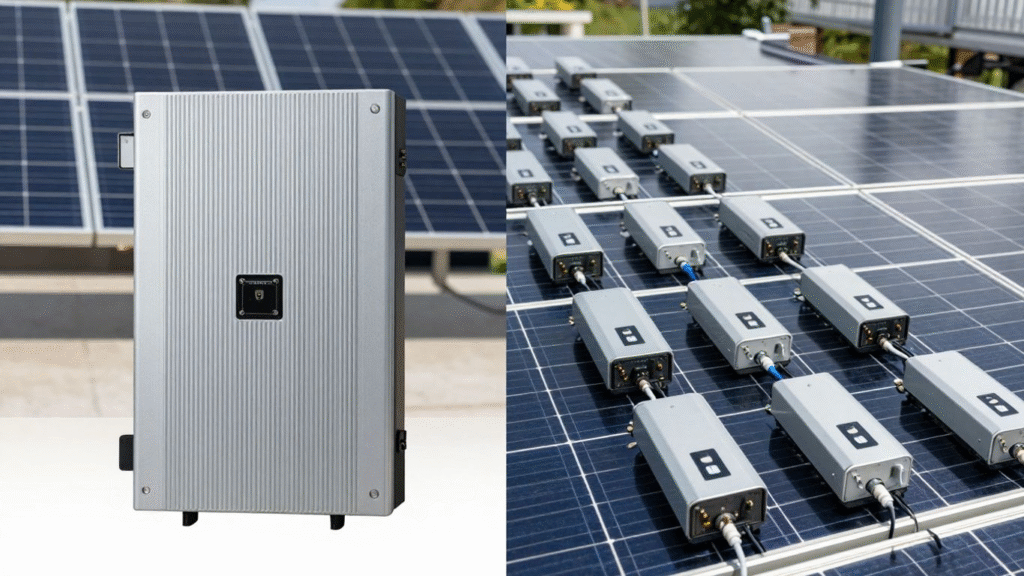
Well, let’s discuss string inverters. They are likely the type you’ll come across most often when people talk about solar power systems. So it’s sort of like the central conduit for your solar power.
How String Inverters Work
In essence, a string inverter takes the direct current (DC) electricity that all of your solar panels create and converts it to alternating current (AC), which is what powers your home devices and can be returned to the grid. The “string” part refers to the way the panels are wired. You wire several solar panels together in a series configuration, like beads on a string, and this “string” then runs to a single large inverter. This inverter is typically installed somewhere easily accessible (the side of your home near the electrical meter, often).
It’s the workhorse that turns your solar power into something you can use. The effectiveness of this process is especially crucial when it comes to optimizing your solar set-up. You can learn about how a solar string inverter converts DC to AC power most effectively here.
String Inverters: Pros and Cons
String inverters, like everything else in solar, have their ups and downs.
Pros:
- Affordable: String inverters are also usually more cost-effective than other inverter solutions.
- Ease of Design: They are easy to design, so they may be simpler to grasp and handle for simple systems.
- Simpler Troubleshooting (for whole system problems): If there’s a problem with the inverter itself, the source of the issue is often easier to identify as being caused by the inverter for the entire system.
Cons:
- Impact of shading: This is a major one. Even a single panel in a “string,” as such groupings are known, becomes shaded or dirty and the performance of the entire string is depressed. Think one slower runner dragging down an entire team — sort of like that.
- Poor monitoring: you see just the total production of 4 months, not how well every single panel is working.
- Expansion hurdles: Expanding with additional panels later on may be more difficult or expensive than other systems.
Some people, in order to overcome the shading issue on string inverters, put in ‘optimizers.’ These tidy little devices attach to each panel and enable it to operate at its peak, even if others in the string are impaired. It’s as if each runner had their own coach accompanying them. That’s going to drive the cost up, but it can still be cheaper than simply using a different inverter technology altogether and allows you to get more power out of each panel.
What is a Microinverter?
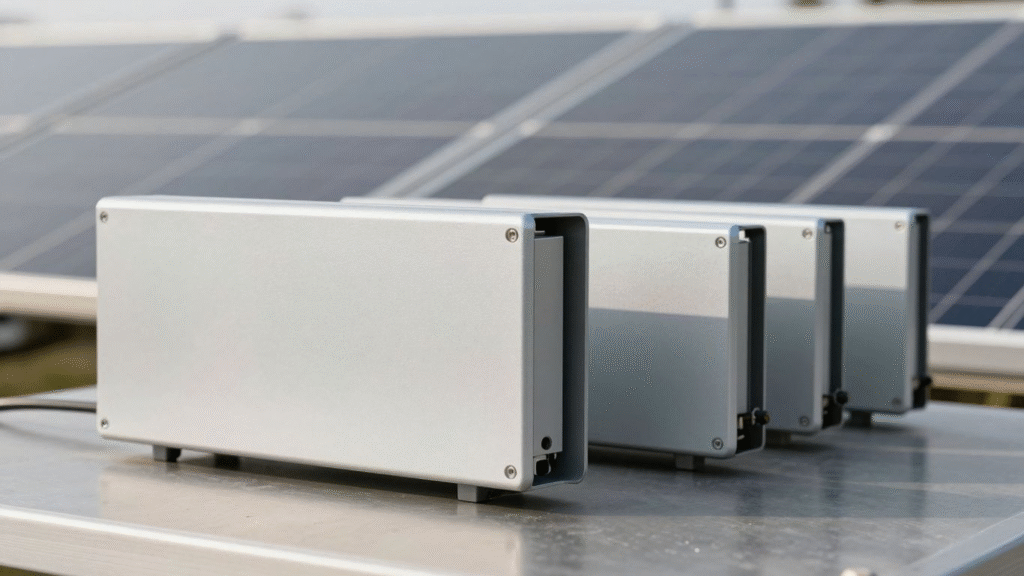
All right, so let’s talk about microinverters. These little guys are like the tiny superheroes for each of your solar panels. Unlike a large central inverter, which deals with dozens of panels at once, a microinverter is installed directly onto the back of each solar panel. Its function is to receive the direct current electricity the panel generates and convert it into alternating current electricity, or AC, which your house runs on. For some microinverters, that can be two panels, but the fundamental concept is that each panel receives its own conversion unit.
How Microinverters Work
And how does this work in the real world? Every solar panel produces DC energy. This DC electricity is immediately fed to the microinverter affixed to it. The microinverter works its magic, turning that DC power into AC power.
From there, the AC electricity generated by each microinverter goes immediately into your home’s electrical system or back out into the grid. Under this panel-by-panel method, if one panel is not producing well, perhaps, it’s slightly shaded, it does not bring down the entire system. It’s like a team where everybody is just on their own, and nobody can be slowed down by one person having a bad day.
Pros and Cons of Microinverters
As with anything, microinverters have their pluses and minuses.
Pros:
- The Performance of Individual Panels: This one is big. If one panel is in shade or malfunctions, it affects only that panel. The other parts of your system continue to chug along.
- Monitoring: You can frequently view the details about how well each individual panel is performing. This way, if one panel starts underperforming, it’s easy to see.
- System Expansion – Want to add panels down the road? Microinverters make this pretty straightforward. You simply add another panel with its own microinverter.
- Safety: Since they convert DC to AC at the panel, there’s less high-voltage DC wires running around, potentially a safety plus.
- Longer Warranties: A lot of microinverters have warranties that run for the same length as the solar panels they pair with — typically 25 years.
Cons:
- Expensive on the Front End: Overall, microinverters are more expensive than a single string inverter when you look at the initial costs for purchase and installation of a system.
- More On-the-Roof Stuff: With a microinverter for each panel, that means more electronic components on your roof. The more that something has parts, the more opportunities for it to fail (but generally these are very reliable).
- Maintenance Can Be More Expensive: If a microinverter does fail, replacing it can be more labor-intensive and therefore costly, than swapping out a central string inverter that might be at ground level.
When considering microinverters, though, it’s all about optimising how much power each individual panel can produce to make the most out of your roof, particularly if you have tricky spots or multiple angles. You get a lot of flexibility going forward if you upgrade your system or need performance information for each panel.
Key Differences: String Inverter vs. Microinverter
So you have your solar panels, but what do you actually do with all that sunshine power? Enter inverters, of which there are two big types, string inverters and microinverters. They perform the same essential job, converting your panels’ DC power into the AC power that your home uses, after all, but they can go about it in some pretty different ways. Let’s unpack what distinguishes them.
Efficiency and Performance
This is a big one. A string inverter, which everyone was once using due to cost, wires up all your panels in series, like a chain. The entire string connects to a single inverter at the center. The catch? A chain is only as strong as its weakest link. If one panel is shaded by a tree branch at certain times of day, or if one panel is slightly more dirt-streaked than the others, it can affect the output of all the panels in its circuit daisy-chained alongside. This is particularly so if your roof has more than one angle or face in different directions.
The microinverters, meanwhile, are small devices attached to the back of each solar panel. Each microinverter converts power from its own individual panel. This means that if one panel is in the shade or underperforming, it does not bring down the others. You receive panel-level optimization, which can lead to higher total energy production, particularly on complex roofs. It’s like you’re hearing individual performers, instead of a choir with one singer who’s off-key.
Shading and Panel-Level Issues
As we mentioned, shading is a key separating factor. If you have parts of your roof that get shade at certain times of the day, or sections obstructed by things like chimneys or vents, microinverters definitely earn their keep. They narrow down what is going wrong to that single panel. With a string inverter, that shade can mean a visible dip in your entire system’s production. It’s not just shading, either panel degradation or even a bad apple in the string set can be a headache for everyone.
Microinverters are very advantageous where shading is erratic or when panels are installed on more than one roof plane. This panel-by-panel control has the advantage that you are less likely to lose a large amount of energy from a single failed panel.
Installation and Maintenance
In general, string inverters are easier to install. You have a single main unit to hook up, and the wiring is simpler. This may sometimes mean cheaper installation costs upfront. Large-scale issues are also generally easier to diagnose, because you’re dealing with one central piece of machinery. But if that single string inverter goes, your entire system goes down.
Microinverters need an inverter for each panel. That’s more parts to install on the roof, which could slow your initial set-up down and even make it cost a bit more. But if one microinverter goes out, only that one panel stops producing power. Plus, you receive granular monitoring for each panel, so it’s easier to pinpoint which panel exactly could be having an issue. Many homeowners like the longer warranties you usually get with microinverters for peace of mind over the long haul.
Which one is best for your solar installation?
Now that you know all about string inverters and microinverters, you might be wondering which one is the best for your home. Well, it’s not exactly a one-size-fits-all answer. It comes down to what your situation is and what you’re looking for out of your solar installation.
Consider your roof, and the sun. A string inverter may be the most budget-friendly if you are using a plain or unshaded roof and it faces primarily south. They generally cost less up front, and if your panels are all getting about the same amount of sun, they work fine. It is like one big brain for all of your panels.
If your roof is complex, with several angles (or parts of it will be shaded by trees or chimneys during part of the day), then microinverters start to seem pretty appealing. And because each panel has its own tiny inverter, a single shaded panel will not drag down the performance of the entire system. It’s as if you’ve given each panel its very own brain, so they can all do their best work even when the conditions aren’t ideal.
Here’s a quick guide to help you choose:
- Shading: If you have a lot of shading on some panels, microinverters are typically the better way to go. They cause each panel to function separately.
- Complexity of roof: Are there several planes or faces? Microinverters handle this better.
- Future Expansion: Do you want to add more panels further down the line? This process is much simpler and sometimes less expensive than adding yet another string inverter.
- Cost: String inverters tend to be more economical in terms of initial capital investment.
- Monitoring: Microinverters come with panel-level monitoring, which can be super handy for pinpointing problems of a specific panel.
At the end of the day, your best bet would be one that maximizes energy production and savings in perpetuity, while taking into account your certain home characteristics and your personal goals for generating power. Feel free to chat with a couple of solar installers; they can help you assess the pros and cons for your configuration.
So, Which One Wins?
Okay, so we’ve looked at string inverters and microinverters, and the truth is, there isn’t really one ‘best’ solution for everyone. An inelegant string inverter system could be the one for you if all that’s standing between your roof and a huge solar array are sinister clouds.
But if you have trees to throw the panels into shadow, your panels face different directions, or you just want to know what every single panel is doing all the time, microinverters really start to look good. They also make it a little easier to add more panels at a later date. Consider your particular installation, your budget and what you’re trying to achieve with solar. That’s how you’re going to determine which kind is the right one for your home.
Frequently Asked Questions
What does a solar inverter do exactly?
Imagine a solar inverter as the translator for your solar panels. This is because Solar Panels generate a form of electricity called Direct Current (DC). Your home and the power grid use a different one called Alternating Current (AC). The inverter is what takes direct current (DC) power from your solar panels and turns it into alternating current (AC), which you can use to power things in your house or export back to the grid.
How does a string inverter differ from a microinverter?
The big difference is where they go to work. String inverter: All of your panels are wired together in a “string” and send their power to one big inverter—you could think of it like a central hub. In contrast, a microinverter is small and affixed to the back of each individual solar panel, where it converts the power before it goes anywhere.
How does shading of one of the solar panels occur with a string inverter?
With a regular string inverter, if just one panel on the string is covered by shade or has an issue, it can slow down power production for the entire set of panels connected to that inverter. It would be as though one slow walker could bring an entire line of people to a halt.
For varied-angle roofs or some shade: Can microinverters help?
Yes, microinverters are perfect for that! Each panel has its own inverter, so if one gets shaded by a chimney or is on a separate part of the roof, it won’t compromise how well the others function. Each panel can shine at its best, regardless of what is happening with its neighbors.
What type of inverter generally has the longest life or best warranty?
Microinverters are typically accompanied by a longer warranty up to the life of your solar panels (typically about 25 years). String inverters tend to come with shorter warranties, often in the 10-12 year range. This extended warranty for microinverters could provide a little more peace of mind in the years ahead.
Is it more costly to set up a microinverter system?
Typically, yes. The upfront costs of purchasing and installing microinverters are usually more than those for a single item, string inverter. Nonetheless, some people believe the added expense is worth it for features such as improved performance in shaded locations, individual panel monitoring, and extended warranties.